Move your records. Run operations with accounting built in.
Kramvia ERP brings pharmacy operations, a transaction-linked accounting core and audit review into one product. A reviewed migration path helps distributors and wholesalers establish a checked opening position before starting work in Kramvia. Current use remains subject to an agreed pilot scope.
FOLLOW THE WORKFLOW
See how the work fits together.
01Review legacy exports
02Accept opening stock & balances
03Run purchases & sales
04Review accounting & corrections
FICTIONAL WORKFLOW EXAMPLE
A purchase, its accounting entry and a later correction
A fictional distributor receives a batch of stock. The supported purchase workflow records the operational document and its linked accounting entry. A later commercial correction is reviewed through its own record, so the original transaction remains traceable.
The useful connection is document → accounting effect → review history. Exact pilot scope determines which documents and corrections are included.
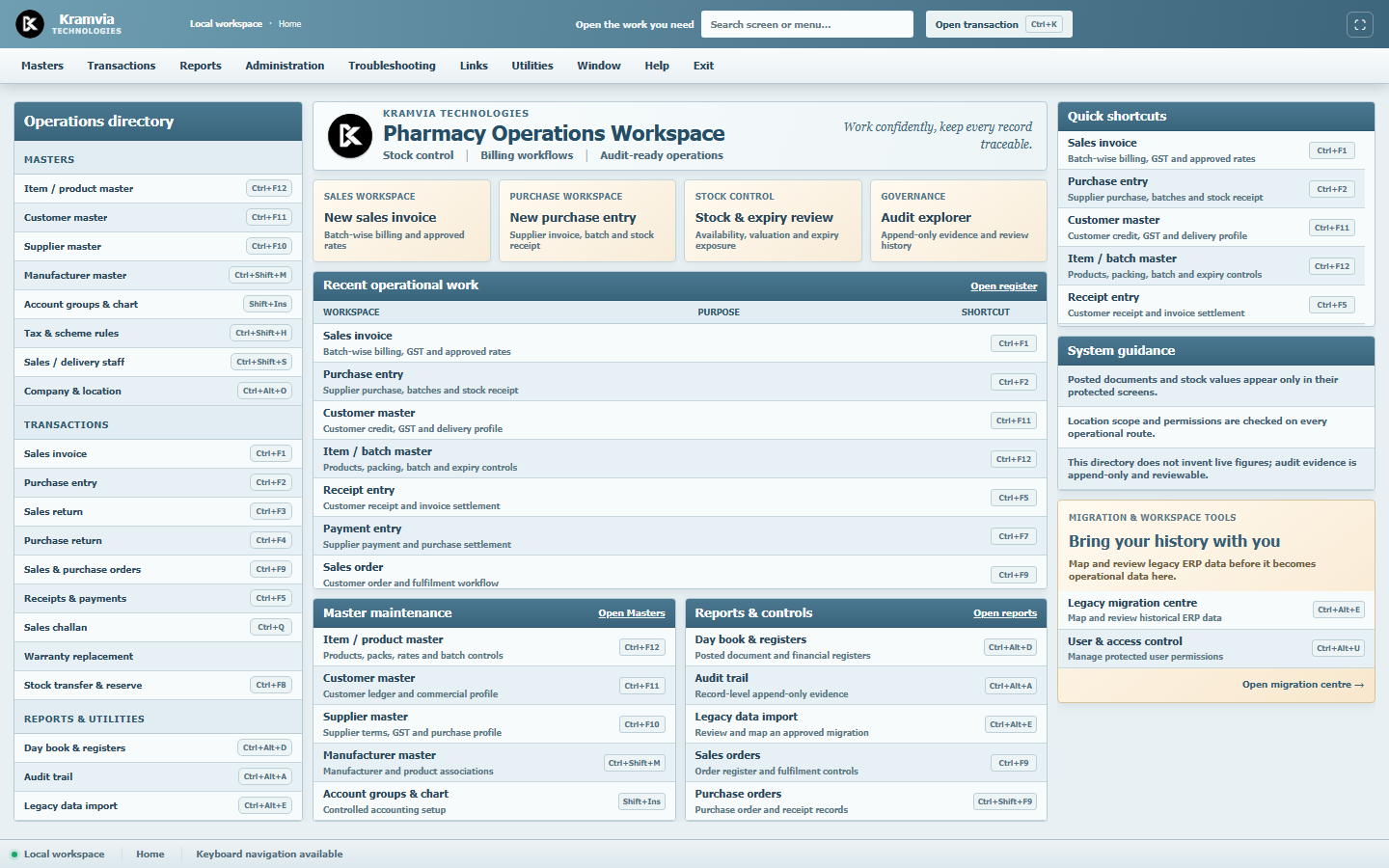
Development workspace screenshot. A visible module or menu is not evidence of production availability.
Begin with a reviewed migration
The current EasySol CSV adapter stages manufacturers, products, parties, opening stock and party opening balances for review. Other systems and historical documents need separate support confirmation before a migration is planned.
Map source columns and review duplicates or invalid rows.
Retain supported legacy references without overwriting existing master values.
Reconcile stock and balance totals against the final export before accepting the opening position.
Start at purchase receipt
A receipt needs more than a product name and quantity. The operational record must preserve the supplier, batch, expiry and commercial context used by the team later in the day. Existing master data and unit conventions need review before migration.
Map products, suppliers and packing units before loading balances.
Check batch numbers, expiry dates and purchase quantities against source records.
Agree how returns and corrections will be reviewed in the pilot.
Carry stock context into sales
Billing and inventory decisions belong in the same operational conversation. A team should be able to understand which stock a transaction refers to, rather than reconstructing the movement from separate files.
Discuss the locations and stock views your business actually uses.
Review billing, discounts and commercial terms against representative examples.
Identify who should approve changes to an operational record.
Keep accounting and audit close to the operation
Supported operational documents and settlements create linked accounting entries. The ERP also includes a permissioned audit explorer and controlled correction workflows. Standalone Ledger is not required to obtain this accounting core.
Review transaction-linked journals and party balances.
Preserve original records when using supported correcting entries.
Confirm broader financial statements, GST returns and integrated bank reconciliation separately; they remain unfinished.
Introduce a bounded pilot
A pilot should test a defined workflow with a responsible reviewer and an agreed way to compare results. It is not an unrestricted production launch or a promise that every existing system can be migrated automatically.
Select an initial location and a manageable set of transactions.
Compare quantities, balances and registers with agreed reference records.
Record issues and agree the next scope before extending use.
CURRENT PRODUCT SCOPE
What is implemented. What still needs work.
Reviewed 22 September 2026. “Implemented scope” describes specific development work; it is not unrestricted production availability.
Implemented scope
EasySol CSV migration
Defined masters, opening stock and party balances, with mapping and review. Other ERP adapters and full historical migration are not established as supported.
Implemented scope
Pharmacy operations
Pilot-core purchasing, sales, batch and stock workflows. Exact document and operational scope must be agreed.
Implemented scope
Transaction accounting
Linked journals, settlements and party balances. This does not mean every accounting statement is complete.
Implemented scope
Audit review and corrections
Permissioned audit explorer and defined correction workflows. Full event coverage, exports and retention are separate requirements.
Validation remaining
Deployment and customer acceptance
Production hardening, LAN/TLS deployment, recovery evidence and customer acceptance remain release gates.
In development
Financial statements, GST returns and bank reconciliation integration
Broader financial reporting and statutory outputs are unfinished. No direct filing availability is implied.
No. ERP has its own transaction-linked accounting core. Ledger is a separate product for businesses that want to keep another ERP.
Does an implemented module mean the ERP is ready to go live?
No. Defined development slices are implemented, but deployment, recovery and customer acceptance gates remain. Broader statements and statutory outputs also need completion.
What to bring to the discussion
Your current software and number of operating locations.
The purchase-to-sale steps that cause the most repeated work.
Fictional examples of a purchase, sale, return and stock adjustment.